
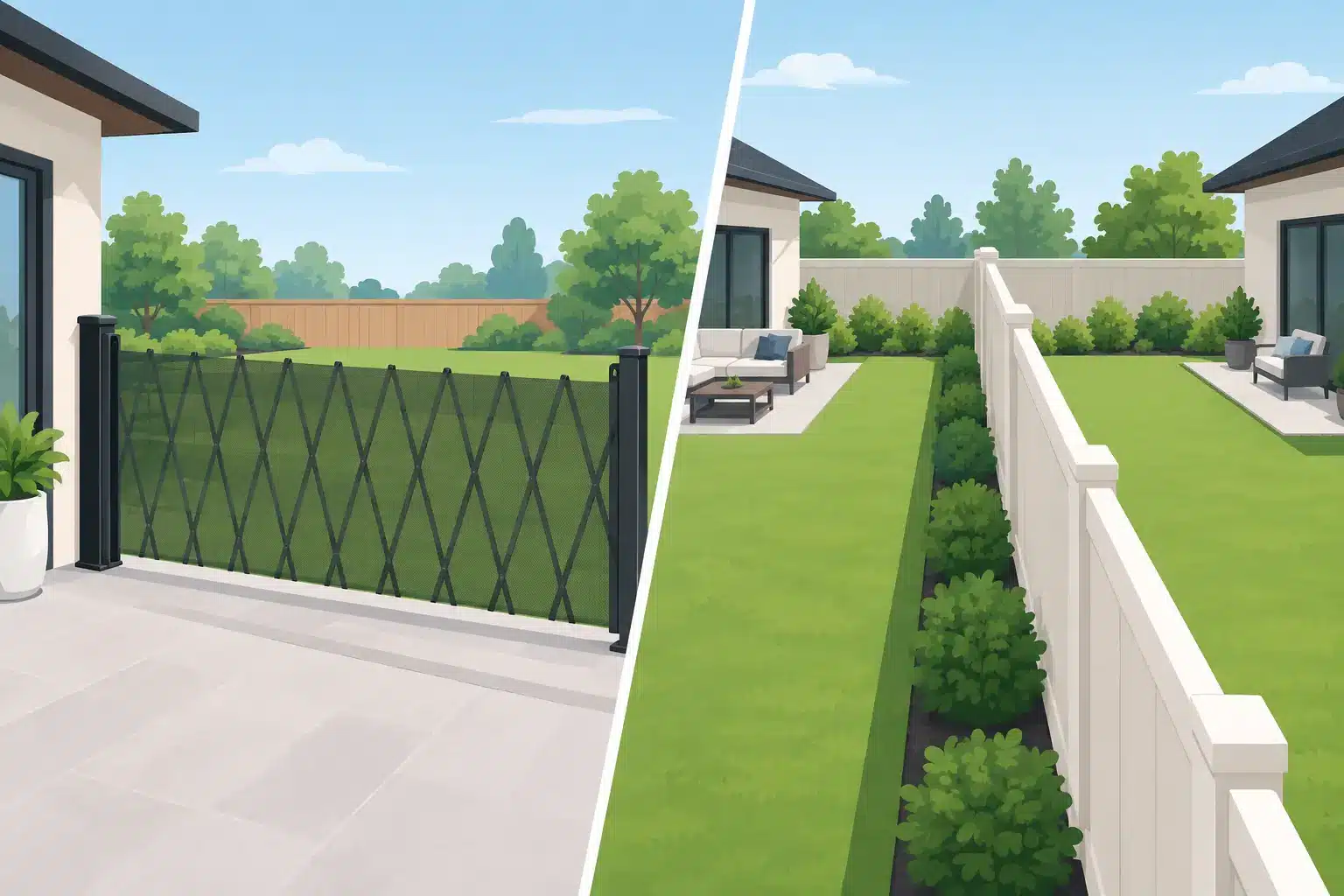
Two neighboring desert villas can look nearly identical on a listing page, yet the way their outdoor spaces connect can change the entire trip. Retractable fencing versus separate yards is not a small design detail when you are planning a Joshua Tree wedding weekend, a bachelorette escape, or a family reunion with multiple households. It determines whether the group naturally gathers in one sunlit setting or spends the weekend texting, “Which house are you at?”
For groups, the best answer is rarely about having the biggest yard. It is about having the right amount of togetherness, with privacy still close at hand. A retractable fence offers flexibility that fixed property lines cannot: one shared setting when the celebration is underway, two private retreats when the day slows down.
What Separate Yards Do Well
Separate yards are the traditional choice for neighboring vacation homes. Each villa has its own pool, spa, lounge areas, outdoor dining space, and entrance. If two couples want a quiet desert weekend while traveling near friends, that arrangement has a clear appeal. Everyone can enjoy their own pace without feeling as though they are staying in one oversized house.
This setup also works well when the guest list includes different schedules. Early risers can make coffee by one pool while night owls sleep in next door. Families with young children can keep their routine contained, and guests who want a quieter evening have an easy place to retreat. There is no need to negotiate every meal, playlist, or pool hour.
For some groups, that separation is the point. Two families may want to share a destination without sharing every square foot. Couples attending the same event may enjoy being close enough for dinner but far enough apart for the stay to still feel personal. Fixed, separate yards create an uncomplicated boundary, and boundaries can be a luxury.
The trade-off appears when a larger group wants to spend real time together. With separate yards, one home typically becomes the unofficial gathering house. People carry plates, towels, drinks, and games back and forth. Hosts may feel like they are managing a rotation rather than relaxing into the weekend. Even when the villas sit side by side, the outdoor experience can remain divided.
Retractable Fencing Versus Separate Yards for Groups
Retractable fencing changes the rhythm of paired-villa travel. When the fence is open, two neighboring outdoor areas can become one larger shared environment. Instead of choosing whose pool to use or splitting the group between patios, guests can move naturally between spaces. One side can hold a long lunch, another can become the pickleball or pool zone, and both homes remain close enough that no one misses the moment.
That flexibility matters most when the property itself is part of the itinerary. In Joshua Tree, the best hours often happen outside: a slow morning after a hike, an afternoon in the pool, a sunset dinner, then music and conversation under a dark desert sky. A connected yard gives a larger group room to spread out without fragmenting.
It is especially useful for milestone weekends. A birthday group may want everyone around for the main dinner, while a few guests take a break in the spa or head inside to get ready. Friends on a bachelor or bachelorette trip can create one lively daytime hub without asking half the group to commute across town. Wedding parties can use the shared setting for a welcome dinner, recovery brunch, or relaxed pre-ceremony gathering while preserving private bedrooms and bathrooms across two homes.
The advantage is not simply more space. It is choice. Open the connection for the moments designed to be shared. Close it when each household wants its own poolside afternoon, private conversation, or early night.
The Privacy Question Is More Nuanced Than It Sounds
A common concern is that connected outdoor space means giving up privacy. It can, if the homes are not thoughtfully designed or if the fence remains open all weekend. But a retractable boundary is valuable precisely because it is not permanent.
For two families, this can mean a shared cookout on the first night and separate pool time the next day. For a wedding group, it can mean a connected outdoor setting before the celebration, then two distinct villas for different parts of the party to decompress. The fence allows guests to choose the social temperature rather than being locked into a single setting.
Privacy also depends on how a group uses the homes. If one villa is designated for guests with children and the other for adults, separate yards may make the logistics easier. If the group has a guest who needs quiet, keeping the spaces divided can be considerate. On the other hand, if everyone has traveled from Los Angeles or San Diego for a two-night escape, many groups find that the shared setting reduces friction and makes the short time together feel fuller.
The practical question is not, “Do we want privacy or connection?” It is, “When will we want each?” A flexible boundary answers both.
When a Shared Outdoor Setting Makes the Most Sense
A connected yard is a natural fit when the group is traveling as one occasion rather than simply sharing a destination. Think reunions, milestone birthdays, friend trips, wellness weekends, and wedding accommodations where the people staying together already expect to gather.
It also makes sense for groups that value the rental as the destination. If the plan includes pool afternoons, a casual tournament, a chef-style dinner at home, or a night of stargazing, the ability to use both outdoor areas as one setting adds real value. Guests have room to be social without being crowded around one patio table or one pool.
At Meridian Collection, matched neighboring villas are designed around this idea. Reserve one home for an intimate desert reset, or reserve the pair for a larger group of up to 16 people. The retractable fence makes it possible to create a shared indoor-outdoor flow while keeping each villa, its bedrooms, and its private amenities available as its own retreat.
For people getting married in Joshua Tree, this paired format can simplify a weekend that already has enough moving parts. Rather than separating close friends or family across multiple distant rentals, guests can stay next door, gather easily, and still have an independent place to get ready or rest. It is accommodation that supports the celebration without trying to turn the villa into a formal event venue.
When Separate Yards May Be Better
Flexibility does not mean the shared option is always the right one. If your group includes people who do not know one another well, separate yards can reduce pressure and give everyone a comfortable amount of personal space. The same is true for travelers with very different budgets, bedtimes, or expectations for noise and activity.
Separate yards may also be preferable if each villa is functioning as a fully independent trip. Perhaps one group is visiting the national park at dawn while the other wants slow pool days. Perhaps grandparents are traveling with one family and friends with another. In those cases, side-by-side homes provide convenience without requiring a combined social plan.
There are also basic good-neighbor considerations. An open connection is ideal for the guests who are part of the same reservation and gathering. It is not permission for an unlimited guest list or late-night noise. A polished group weekend still benefits from a clear plan: know who is staying where, keep outdoor volume reasonable, and choose a home layout that fits the number of overnight guests.
How to Choose Before You Book
Start with the shape of the weekend, not just the headcount. Ask where people will spend the most time and whether you want meals, pool time, and evening conversations to happen together by default. If the answer is yes, retractable fencing can make two homes feel like one expansive desert compound while preserving the comfort of separate sleeping spaces.
Then consider the quiet hours. Who needs an early bedtime? Are there children, light sleepers, or guests who may want an afternoon away from the group? A paired-villa stay works best when everyone understands that connection is available, not mandatory.
Finally, think beyond the main event. A wedding, bachelor party, or bachelorette trip may have a packed schedule, but the hours around it are often what guests remember: coffee in the clear morning light, the first swim after checking in, a late dinner with no one watching the clock. Choose a setting that gives those unscripted moments room to happen.
The desert does not ask a group to do everything together. It simply gives everyone enough space to gather when it feels right, then step back into a place that is entirely their own.