
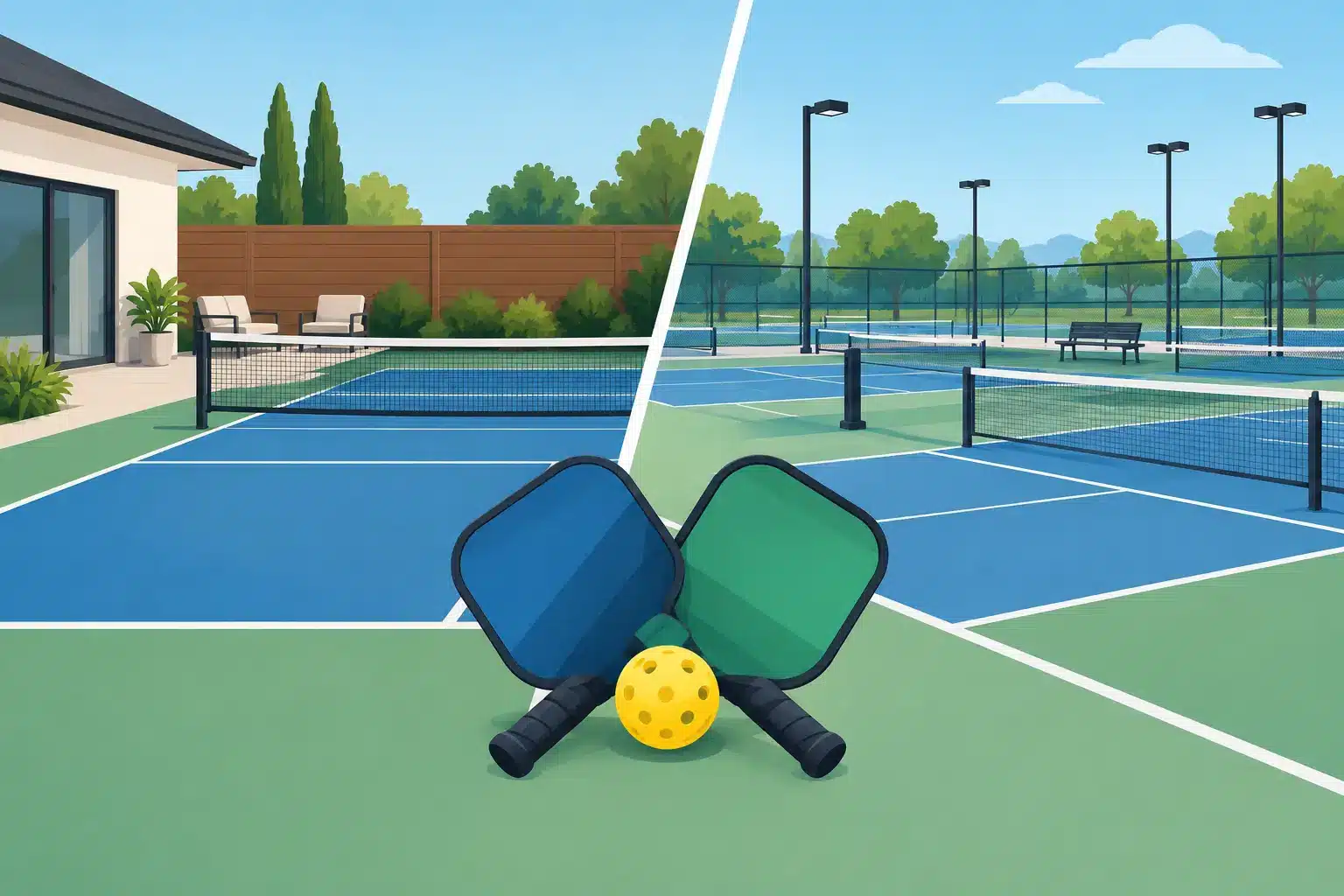
A pickleball court can shape the rhythm of an entire weekend. With private pickleball versus public courts, the difference is not simply where you play. It is whether the game fits around your plans, or your plans have to fit around the game.
For a Joshua Tree escape, that distinction matters. Your group may want a relaxed morning rally before coffee, a tournament between pool sessions, or one more game under the desert sky after dinner. At a public court, those moments can depend on parking, availability, waitlists, noise, and the preferences of people you have never met. At a private villa, the court is already part of the stay.
Private Pickleball Versus Public Courts: The Real Difference
Public courts have a genuine appeal. They are social, accessible, and often a good choice for local players looking to meet new opponents. If you are traveling solo, staying nearby for a week, or want to plug into a local playing community, a public facility can be a fun part of the trip.
But a group getaway has different needs. Friends and families do not usually arrive in the desert hoping to coordinate open-play rotations with strangers. They want room to settle in, make a playlist, laugh through questionable line calls, and take a break when the pool looks more appealing than the next set.
A private court gives your group control over the pace. There is no court clock, no need to pack everything into the car, and no uncertainty over whether a game can happen at all. You can play competitively, casually, or not at all until someone says, “One game before dinner.” That freedom is the point.
What Public Courts Do Well
Public pickleball is not automatically the lesser option. It can be the right call when convenience and community matter more than exclusivity.
A dedicated public facility may offer multiple courts, steady activity, and the chance to find players at your skill level. Serious players sometimes enjoy the variety of opponents and the structure of scheduled open play. For guests who want to improve their game, meet locals, or play several hours without needing a full group, those are meaningful advantages.
The trade-off is that the experience is shared. Peak times can mean waiting between games or joining a rotation. Court etiquette, guest policies, parking, operating hours, and lighting all vary by location. Even a beautiful public court can feel less relaxing when half the group is waiting on the sidelines while the other half is playing.
For a quick morning workout, that may be perfectly fine. For a two- or three-night celebration where the property itself is meant to be the destination, it can add unnecessary logistics.
Why Private Courts Work Better for Group Trips
The best group weekends leave room for different versions of fun. One couple may be making breakfast while another starts a doubles match. Someone may play one game, then disappear to the spa. A teenager may practice serves for 20 minutes while the rest of the group lounges nearby.
That easy overlap is difficult to recreate at a public court. A private pickleball court keeps everyone close to home base, with cold drinks, bathrooms, shade, music, swimsuits, and the rest of the weekend within reach. There is no dividing the group into drivers and non-drivers, players and spectators, or early arrivals and latecomers.
Privacy also changes the energy. Not every game needs an audience. Your group can be loud, competitive, rusty, playful, or all four at once without worrying about disrupting another reservation. For many guests, especially those who spend most weekdays in crowded cities, having the space to relax without being observed is its own luxury.
More Time Playing, Less Time Coordinating
The hidden cost of public courts is often time. Getting there, finding parking, checking court availability, waiting for a turn, and getting everyone back to the house can take a significant piece of the day. That is manageable when pickleball is the main event. It is less appealing when it is one part of a weekend built around meals, pool time, hiking, and long, unhurried conversations.
At a private villa, pickleball can be spontaneous. Start a game at daybreak. Pause because brunch is ready. Pick it up again at sunset. The court does not ask your group to choose one activity over another.
Better for Mixed Skill Levels
Most travel groups include a range of players. One person may have their own paddle and strong opinions about the kitchen line, while another is trying pickleball for the first time. Public open play can be intimidating for beginners, particularly when courts are busy and more experienced players are waiting.
Private play makes room for everyone. Beginners can learn without pressure, and confident players can turn up the competition when the group is ready. There is no need for every match to be perfectly balanced. A lopsided game can still be the one everyone talks about over dinner.
The Court Matters, but So Does Everything Around It
A private court is most valuable when it belongs to a well-designed outdoor setting. The game is better when it is steps from the pool, connected to places to sit, and part of a home where the rest of the group has equally good options.
That is especially true in the high desert. Joshua Tree is made for contrast: bright mornings, warm afternoons, and evenings when the stars take over. A private court can be one chapter in the day rather than a separate outing. Play a few games, cool off in the pool, put something on the grill, then settle in outside as the temperature drops.
For larger groups, the surrounding layout becomes even more important. A court may draw everyone together, but private bedrooms, generous kitchens, indoor-outdoor gathering areas, and enough space to spread out keep the stay comfortable. The goal is not to schedule every minute. It is to have enough on hand that no one needs to leave to find a good time.
Weddings, Bachelor Parties, and Bachelorette Weekends
For guests getting married in Joshua Tree, a private pickleball court gives friends and family an easy way to connect between wedding events. There may be a welcome dinner, photos, venue coordination, and a full day ahead. A low-stakes doubles match at the house is simpler than organizing another outing, and it gives guests who do not know each other well a natural way to mingle.
Bachelor and bachelorette trips benefit from the same flexibility. The best celebrations have energy without becoming overplanned. A friendly bracket, a couples-versus-couples match, or a late-afternoon rally can create a centerpiece without requiring tickets, transportation, or a fixed start time. The people who would rather float in the pool or sit in the shade can still be part of it.
For groups of up to 16, paired neighboring villas can make the format even more useful. The group has room to gather together while each household still has its own place to reset. At Meridian Collection, matched homes can be reserved individually or together, creating a private setting that feels built for the way groups actually travel.
When Public Courts May Still Be the Better Choice
There are a few cases where public courts win. If your group is made up of dedicated players who want multiple courts, fresh competition, and a more club-like atmosphere, public play may add something a single private court cannot. The same is true if you are staying somewhere without a court and only need an hour or two of play.
Public courts can also be a good change of pace on a longer stay. You might spend one morning meeting local players, then return to the villa for the rest of the day. It does not have to be an either-or decision.
Still, for most desert weekends, the question comes down to what you want to protect: your time, your privacy, and the easy feeling of being together without an agenda. Choose the court that lets the group play when it wants to, then get back to the pool before the next round starts.